
Not every president leaves his greatest mark while serving in the White House. John Quincy Adams (1825–1829) was one of the most experienced men ever to become president, yet his single term was filled with political resistance and frustration. In many ways, his story becomes even more interesting after his presidency, when he continued public service in Congress and became a powerful voice against the expansion of slavery. The John Quincy Adams word search introduces students to a leader whose life stretched across diplomacy, politics, reform, and moral debate.
Adams belonged to one of the most important political families in early American history. He was the son of John Adams, the second president, but his own career was remarkable even without that connection. As a young man, he spent time in Europe, learned diplomacy early, and later represented the United States in several foreign posts. He helped negotiate the Treaty of Ghent, which ended the War of 1812, and became secretary of state under James Monroe.
His work as secretary of state was especially important. Adams helped shape major foreign policy decisions, including the ideas behind the Monroe Doctrine. He also supported the Adams-Onís Treaty, through which Spain ceded Florida to the United States. These achievements made him one of the most influential diplomats of the early republic before he ever became president.
The election of 1824 was controversial. No candidate won a majority of electoral votes, so the decision went to the House of Representatives. Adams became president after defeating Andrew Jackson, but Jackson’s supporters accused him of benefiting from a “corrupt bargain.” That accusation weakened Adams politically from the beginning and made it harder for him to govern.
As president, Adams believed the federal government could support roads, canals, education, science, and national improvement. His vision was ambitious, but many opponents thought his plans gave too much power to Washington. Political resistance blocked much of his program, and he lost the election of 1828 to Jackson.
After leaving the White House, Adams returned to public life as a member of the House of Representatives. There, he became known for opposing the “gag rule,” which tried to silence anti-slavery petitions. This John Quincy Adams word search highlights diplomacy, Florida, national improvement, political conflict, and the long fight over slavery. His life shows that influence in American history does not always fit inside one presidential term.
Continue into the Jacksonian Era and Westward Expansion Presidents with our Andrew Jackson word search, Martin Van Buren word search, John Tyler word search, and the full US Presidents Word Searches collection.
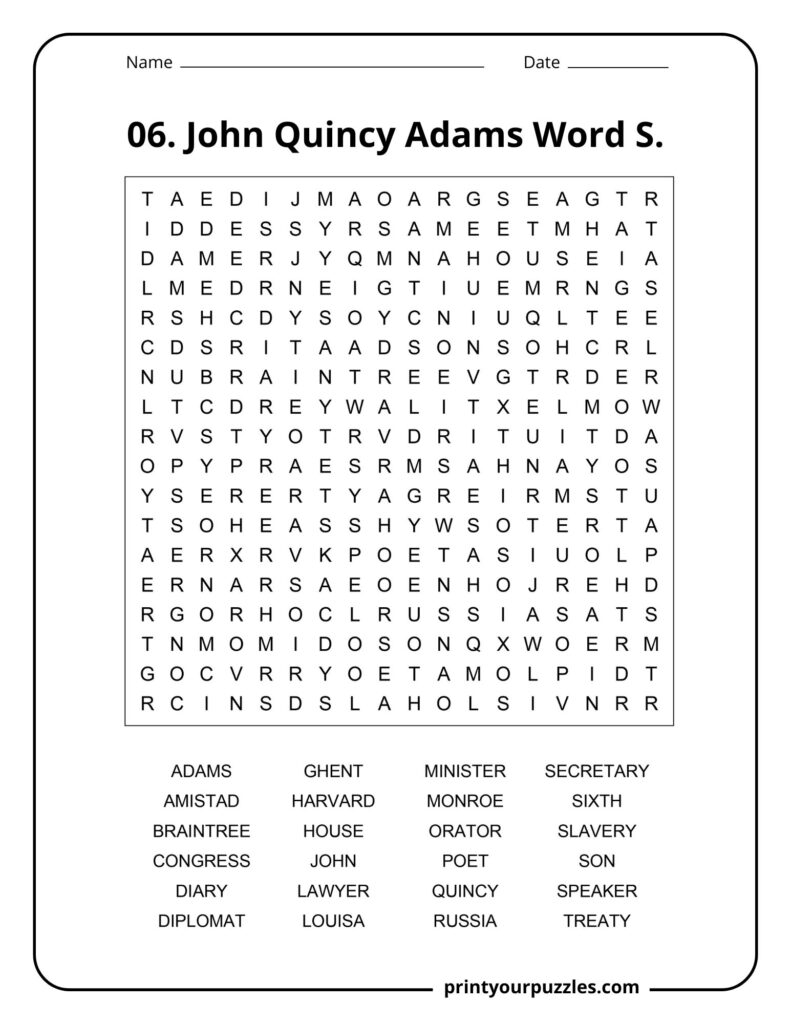
ADAMS, AMISTAD, BRAINTREE, CONGRESS, DIARY, DIPLOMAT, GHENT, HARVARD, HOUSE, JOHN, LAWYER, LOUISA, MINISTER, MONROE, ORATOR, POET, QUINCY, RUSSIA, SECRETARY, SIXTH, SLAVERY, SON, SPEAKER, TREATY
ADAMS – Family name of John Quincy Adams, sixth U.S. President and son of second President John Adams, representing America’s only father-son presidential dynasty until the Bushes.
AMISTAD – Spanish slave ship involved in 1841 rebellion; Adams successfully defended African captives before Supreme Court, arguing for their freedom at age seventy-three, demonstrating his anti-slavery commitment.
BRAINTREE – Massachusetts town where John Quincy Adams was born on July 11, 1767; later renamed Quincy in honor of his maternal grandfather, Colonel John Quincy.
CONGRESS – Legislative body where Adams served as U.S. Representative for seventeen years after his presidency, the only former president to serve in the House of Representatives.
DIARY – Adams kept detailed personal journals for over sixty years, creating one of American history’s most comprehensive records of early republic politics, diplomacy, and daily life.
DIPLOMAT – Adams served as minister to Netherlands, Prussia, Russia, and Britain, negotiating treaties and representing American interests abroad before becoming Secretary of State under Monroe.
GHENT – Belgian city where Adams helped negotiate the Treaty of Ghent in 1814, ending the War of 1812 between the United States and Great Britain peacefully.
HARVARD – Prestigious Massachusetts university Adams attended, graduating in 1787; he later served as professor of rhetoric and oratory there from 1806 to 1809.
HOUSE – The House of Representatives where Adams served for seventeen years after leaving the presidency, fighting against slavery and the gag rule until his death.
JOHN – First name of John Quincy Adams, named after his maternal grandfather John Quincy; distinguished him from his father, also named John Adams.
LAWYER – Adams practiced law in Boston after graduating from Harvard, establishing his legal career before entering diplomatic service and politics in the early republic.
LOUISA – Louisa Catherine Johnson Adams, John Quincy’s wife, was the only First Lady born outside the United States, born in London to an American father.
MINISTER – Diplomatic title Adams held representing the United States in multiple European countries including the Netherlands, Prussia, Russia, and Great Britain throughout his career.
MONROE – President James Monroe appointed Adams as Secretary of State; together they developed the Monroe Doctrine, warning European powers against colonizing the Americas.
ORATOR – Adams was renowned for his eloquent public speaking abilities, demonstrated in Congress and notably in his nine-hour Supreme Court argument in the Amistad case.
POET – Adams wrote poetry throughout his life, expressing personal thoughts and political views through verse, though he considered himself an amateur in this artistic pursuit.
QUINCY – Massachusetts city, formerly part of Braintree, renamed for Adams’s maternal grandfather; became his lifelong home and where he’s buried at First Parish Church.
RUSSIA – Adams served as minister to Russia from 1809 to 1814, establishing diplomatic relations with Czar Alexander I during Napoleon’s invasion and strengthening American-Russian ties.
SECRETARY – Adams served as Secretary of State under President Monroe from 1817 to 1825, considered one of the greatest in this position for diplomatic achievements.
SIXTH – John Quincy Adams was the sixth President of the United States, serving one term from 1825 to 1829 after a controversial election decided by House.
SLAVERY – Adams became increasingly outspoken against slavery during his congressional career, fighting the gag rule that prevented debate on antislavery petitions in the House of Representatives.
SON – John Quincy Adams was the eldest son of President John Adams and Abigail Adams, making him the first presidential son to become president himself.
SPEAKER – Not House Speaker himself, but Adams was a powerful speaker in Congress, known for his passionate floor speeches against slavery and for human rights.
TREATY – Adams negotiated several important treaties including the Treaty of Ghent ending the War of 1812 and the Adams-Onís Treaty acquiring Florida from Spain.
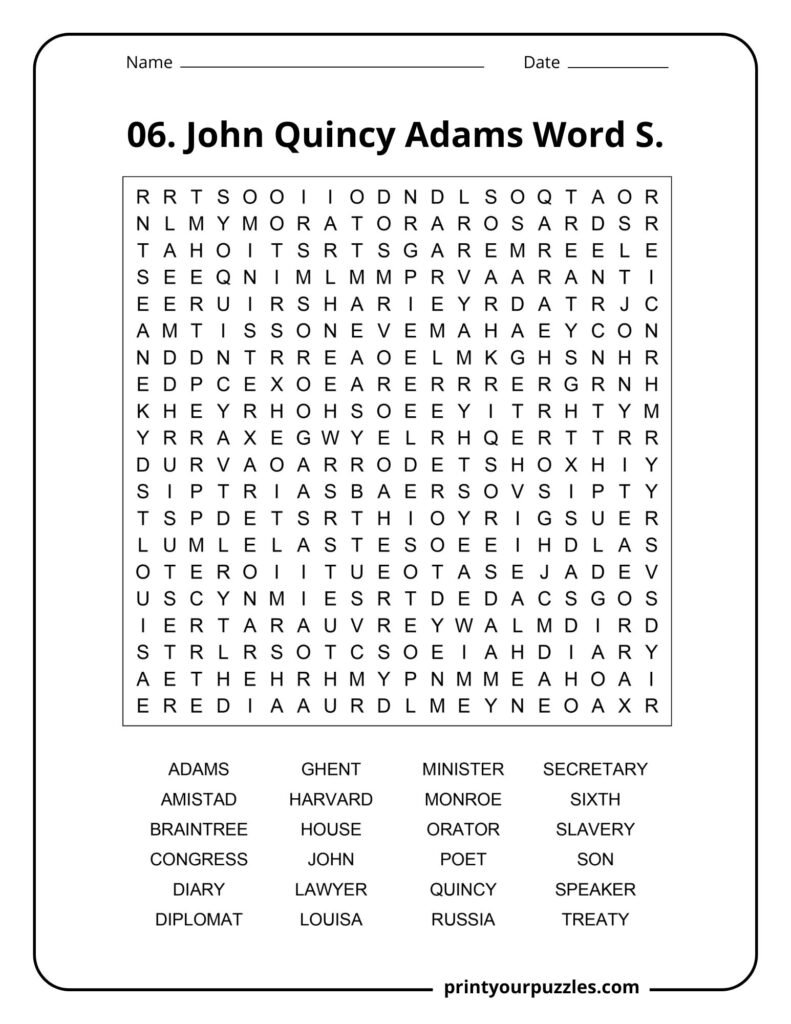
ADAMS, AMISTAD, BRAINTREE, CONGRESS, DIARY, DIPLOMAT, GHENT, HARVARD, HOUSE, JOHN, LAWYER, LOUISA, MINISTER, MONROE, ORATOR, POET, QUINCY, RUSSIA, SECRETARY, SIXTH, SLAVERY, SON, SPEAKER, TREATY
John Quincy Adams was the eldest son of John Adams, America’s second president, and Abigail Adams, making them the first father-son presidential pair in U.S. history.
No candidate won the electoral majority, so the House of Representatives decided the election. Adams won despite Andrew Jackson receiving more popular votes, creating lasting political controversy.
Adams served seventeen years in the House of Representatives, becoming the only former president to serve in Congress. He fought tirelessly against slavery and the gag rule.
The Amistad case involved African captives who rebelled on a Spanish slave ship. Adams, at age seventy-three, successfully argued before the Supreme Court for their freedom.
Adams suffered a stroke on the House floor on February 21, 1848, and died two days later in the Capitol building, literally serving his country until his final moments.
For official administration records and historical biography, visit the John Quincy Adams page in the White House Archives. If you are planning a trip or looking for personal papers, check out the official Stone Library at Adams National Park.
John Quincy Adams: A Man for the Whole People by Randall B. Woods. The most recent and highly praised biography of one of America’s most intellectually gifted presidents, drawing deeply on his remarkable diaries.
Adams swam nude in the Potomac River nearly every morning for exercise. Legend says a female reporter once held his clothes hostage until he granted her an interview.
The Marquis de Lafayette gifted Adams an alligator, which he kept in the East Room bathtub for several months, occasionally showing it to surprised guests and visitors.
Adams mastered English, French, Dutch, German, Latin, Greek, and Russian. He translated German poetry and could read diplomatic documents in their original languages without interpreters.
In 1843, Adams sat for an early daguerreotype photograph, making him one of the first U.S. presidents captured by camera technology, preserving his image for history.
Adams was an avid gardener who personally planted trees and established the first flower garden at the White House, beginning a presidential tradition of White House landscaping.