
The Texas Revolution was a conflict between settlers in Texas and the Mexican government that lasted from 1835 to 1836. At the time, Texas was part of Mexico, but political disagreements, cultural differences, and growing tensions led many Texans to resist Mexican authority. The revolution ended with Texas declaring independence and becoming the Republic of Texas.
During the early 1800s, many settlers from the United States moved into Texas, which was then Mexican territory. Mexico had encouraged some settlement, but problems grew over immigration, local government, slavery, religion, language, and loyalty to Mexican laws. Many settlers wanted more control over their own affairs, while Mexican leaders wanted stronger authority over the region.
One of the main causes of the conflict was the rise of President Antonio López de Santa Anna. Many Texans believed he was weakening the Mexican Constitution of 1824 and creating a more centralized government. Some Texans first wanted their constitutional rights restored, but as the conflict grew, more people began supporting full independence from Mexico.
Several important figures became connected with the Texas Revolution. Stephen F. Austin had helped bring settlers to Texas and later supported resistance. Sam Houston became the commander of the Texan army. Santa Anna led Mexican forces, while William B. Travis, James Bowie, and Davy Crockett became famous for their role at the Alamo.
The revolution included several major events and battles. The Battle of Gonzales in 1835 is often remembered as an early clash. In 1836, Mexican forces attacked the Alamo in San Antonio, where the defenders were defeated after a long siege. Soon after, the Goliad Massacre shocked many Texans and increased determination to continue fighting.
The turning point came at the Battle of San Jacinto in April 1836. Sam Houston’s army defeated Santa Anna’s forces in a short but decisive battle. Afterward, Santa Anna was captured, and Texas independence became a reality. The new Republic of Texas existed for several years before Texas was annexed by the United States in 1845.
The Texas Revolution had long-term consequences, including tensions that later contributed to the Mexican-American War. Students can use this Texas Revolution word search to review vocabulary connected to Texas, Mexico, Alamo, Gonzales, San Jacinto, Houston, Santa Anna, independence, republic, and revolution. These words help connect the causes, leaders, battles, and consequences of this important 1800s conflict.
Related Word Searches:
Mexican-American War | Manifest Destiny | Westward Expansion | James K. Polk | Andrew Jackson | California Gold Rush
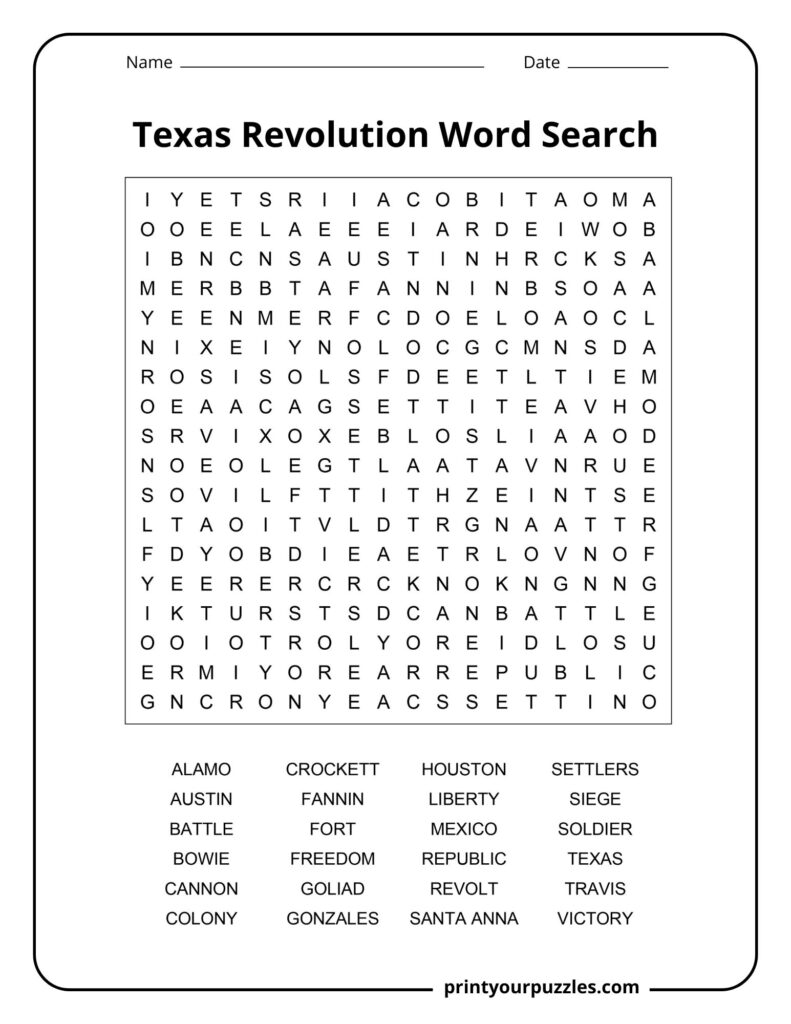
ALAMO, AUSTIN, BATTLE, BOWIE, CANNON, COLONY, CROCKETT, FANNIN, FORT, FREEDOM, GOLIAD, GONZALES, HOUSTON, LIBERTY, MEXICO, REPUBLIC, REVOLT, SANTA ANNA, SETTLERS, SIEGE, SOLDIER, TEXAS, TRAVIS, VICTORY
ALAMO – A former Spanish mission in San Antonio where 189 Texan defenders fought to the death against thousands of Mexican troops in March 1836, becoming a symbol of heroic resistance.
AUSTIN – Stephen F. Austin, known as the “Father of Texas,” who established the first Anglo-American colony in Mexican Texas and initially worked diplomatically before supporting the revolution for independence.
BATTLE – Military engagements fought between Texan forces and the Mexican army throughout 1835-1836, including conflicts at Gonzales, the Alamo, Goliad, and the decisive Battle of San Jacinto.
BOWIE – James Bowie, a legendary frontiersman and inventor of the Bowie knife, who served as a co-commander at the Alamo and died defending the mission during the siege.
CANNON – Artillery piece central to the Texas Revolution, including the small bronze cannon at Gonzales that sparked the conflict when Texans refused Mexican demands to return it.
COLONY – Anglo-American settlements established in Mexican Texas by empresarios like Stephen F. Austin, bringing thousands of American families who eventually sought independence from Mexico’s centralist government.
CROCKETT – Davy Crockett, famous Tennessee frontiersman, congressman, and folk hero who traveled to Texas to join the fight for independence and died defending the Alamo in 1836.
FANNIN – James Fannin, commander of Texan forces at Goliad who surrendered to Mexican troops and was executed along with over three hundred men in the Goliad Massacre.
FORT – Military fortifications used during the revolution, including the Alamo mission converted into a fort and Fort Defiance at Goliad, serving as strategic defensive positions against Mexican forces.
FREEDOM – The fundamental goal of the Texas Revolution: achieving independence from Mexico’s centralized government and establishing self-governance, rights, and liberty for settlers in the Texas territory.
GOLIAD – Site of Fort Defiance where Colonel Fannin’s forces surrendered to Mexican General Urrea, followed by the tragic massacre of over three hundred Texan prisoners of war.
GONZALES – Small Texas settlement where the revolution’s first shots were fired in October 1835, when Texans refused to surrender a cannon, flying a flag declaring “Come and Take It.”
HOUSTON – Sam Houston, commanding general of the Texas army who led the decisive victory at San Jacinto, capturing Santa Anna and securing Texas independence. He later became president.
LIBERTY – The principle driving Texans to revolt against Mexico’s centralist policies, seeking freedom from oppression, the right to self-government, and protection of constitutional rights denied under Santa Anna’s regime.
MEXICO – The nation from which Texas sought independence, governed by General Antonio López de Santa Anna, whose centralist policies and military actions provoked the 1835-1836 revolutionary conflict in Texas.
REPUBLIC – The Republic of Texas, an independent nation established after victory at San Jacinto in 1836, existing as a sovereign country for nine years before annexation by the United States.
REVOLT – The armed uprising of Texas colonists against Mexican authority beginning in 1835, sparked by disagreements over federalism, immigration restrictions, and Santa Anna’s dictatorial centralist government policies and military enforcement.
SANTA ANNA – Antonio López de Santa Anna, Mexican general and president who led the military campaign against Texas rebels, captured at San Jacinto, and forced to recognize Texas independence.
SETTLERS – Anglo-American colonists who migrated to Mexican Texas through empresario grants, eventually comprising the majority population and leading the movement for independence when conflicts arose with Mexico’s government.
SIEGE – The thirteen-day military encirclement of the Alamo by thousands of Mexican troops under Santa Anna, culminating in the March 6, 1836 assault that killed all defenders.
SOLDIER – Individual fighters on both sides of the conflict, including Texan volunteers, militia members, Mexican army regulars, and conscripts who participated in battles throughout the 1835-1836 revolution.
TEXAS – The northeastern Mexican territory that rebelled against centralist rule in 1835-1836, achieving independence and becoming the Republic of Texas before joining the United States in 1845.
TRAVIS – William Barret Travis, young lawyer and lieutenant colonel who commanded the Alamo garrison, wrote the famous “Victory or Death” letter appealing for reinforcements, and died in battle.
VICTORY – The decisive triumph at the Battle of San Jacinto on April 21, 1836, where Sam Houston’s army defeated and captured Santa Anna, securing Texas independence after eighteen minutes.
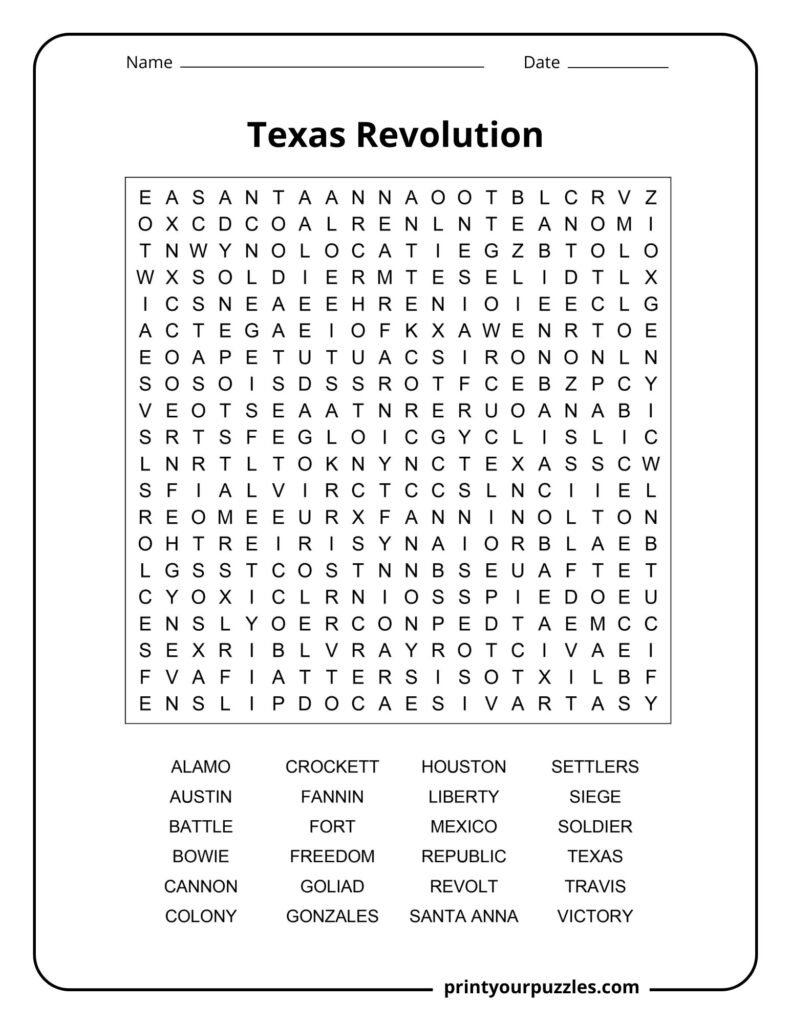
ALAMO, AUSTIN, BATTLE, BOWIE, CANNON, COLONY, CROCKETT, FANNIN, FORT, FREEDOM, GOLIAD, GONZALES, HOUSTON, LIBERTY, MEXICO, REPUBLIC, REVOLT, SANTA ANNA, SETTLERS, SIEGE, SOLDIER, TEXAS, TRAVIS, VICTORY
The Texas Revolution lasted from October 1835 to April 1836, spanning approximately six months of conflict between Texas colonists and the Mexican government under General Santa Anna’s command.
Texans rebelled against Mexico’s centralist policies under Santa Anna, who abolished the federal Constitution of 1824, restricted immigration, imposed taxes, and sent troops to enforce his authoritarian rule.
The Alamo’s thirteen-day siege ended with all 189 defenders killed, but their sacrifice became a rallying cry—”Remember the Alamo!”—that inspired Texans to ultimate victory at San Jacinto.
Sam Houston’s army surprised and defeated Santa Anna’s forces at the Battle of San Jacinto on April 21, 1836, capturing the Mexican general and securing Texas independence in eighteen minutes.
Texas became an independent republic in 1836, existing as a sovereign nation for nine years with its own government, currency, and military before joining the United States in 1845.
The conflict started when Mexican soldiers tried to retrieve a small cannon from Gonzales. Texans refused, creating a flag reading “Come and Take It,” and fired the first shots.
Juan Seguín, a Tejano (Mexican Texan), commanded troops at San Jacinto and served as a Texas senator. Many Mexican-born residents supported the revolution against Santa Anna’s dictatorship.
Despite being the decisive battle that won Texas independence, Houston’s surprise afternoon attack on April 21, 1836, defeated Santa Anna’s army in less than twenty minutes of fighting.
Legend says Travis used his sword to draw a line, asking those willing to stay and fight to cross it. All but one defender chose to remain and face certain death.
The famous frontiersman was a former Tennessee congressman who traveled to Texas seeking new opportunities. He arrived at the Alamo just months before the famous siege and his death.