Introduction to American Revolution Word Search
The American Revolution was a political and military struggle in which thirteen British colonies in North America fought to become independent from Great Britain. Although the war officially lasted from 1775 to 1783, the conflict developed over many years, beginning with growing colonial resistance in 1765.
After the French and Indian War, Britain needed money to pay its debts and defend its territories. The British government introduced new taxes and laws affecting the colonies, including the Stamp Act, the Townshend Acts, and the Tea Act. Many colonists believed these measures were unfair because they had no elected representatives in the British Parliament. Their objection became famous through the phrase “no taxation without representation.”
Tensions increased through protests, boycotts, and confrontations. In 1770, British soldiers killed five colonists during the Boston Massacre. Three years later, protesters carried out the Boston Tea Party by throwing British tea into Boston Harbor. Britain responded with harsh laws known in the colonies as the Intolerable Acts, which further united colonial opposition.
Fighting began in April 1775 at the Battles of Lexington and Concord in Massachusetts. Colonial leaders organized the Continental Army and selected George Washington as its commander. On July 4, 1776, the Continental Congress adopted the Declaration of Independence, mainly written by Thomas Jefferson. The document announced that the colonies were free states and argued that people possessed natural rights, including life, liberty, and the pursuit of happiness.
The war was difficult for both sides. American forces faced shortages of food, equipment, and trained soldiers, while Britain struggled to control a large and distant territory. Important American victories at Saratoga and Yorktown helped change the course of the conflict. France supported the Americans with soldiers, weapons, money, and naval power, making independence more achievable.
The war effectively ended after the British surrender at Yorktown in 1781. The Treaty of Paris, signed in 1783, officially recognized the United States as an independent nation. The Revolution also inspired later movements for political freedom, although many people—including enslaved individuals, Native Americans, and women—did not immediately receive equal rights.
An American revolution word search can introduce important names, places, events, and ideas such as liberty, independence, taxation, Washington, Boston, Saratoga, and Yorktown. Understanding these terms helps readers follow how colonial protest developed into a revolution that created a new country.
Related Word Searches:
Declaration of Independence | Boston Tea Party | Founding Fathers | Treaty of Paris | George Washington | Benjamin Franklin
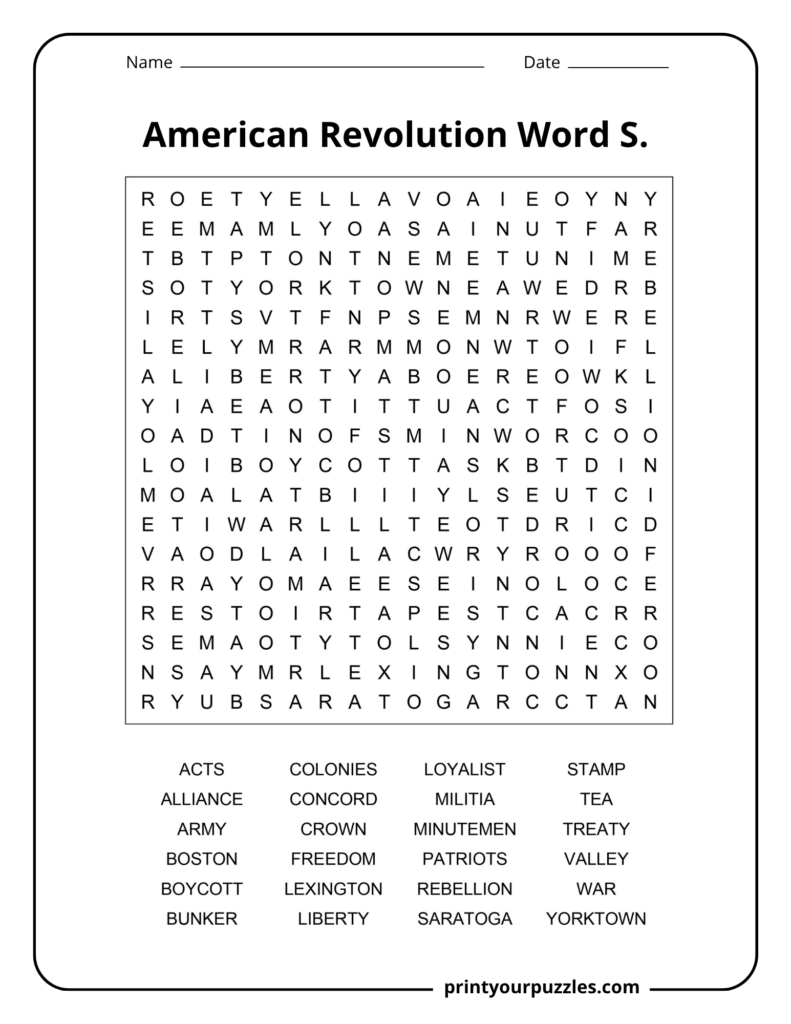
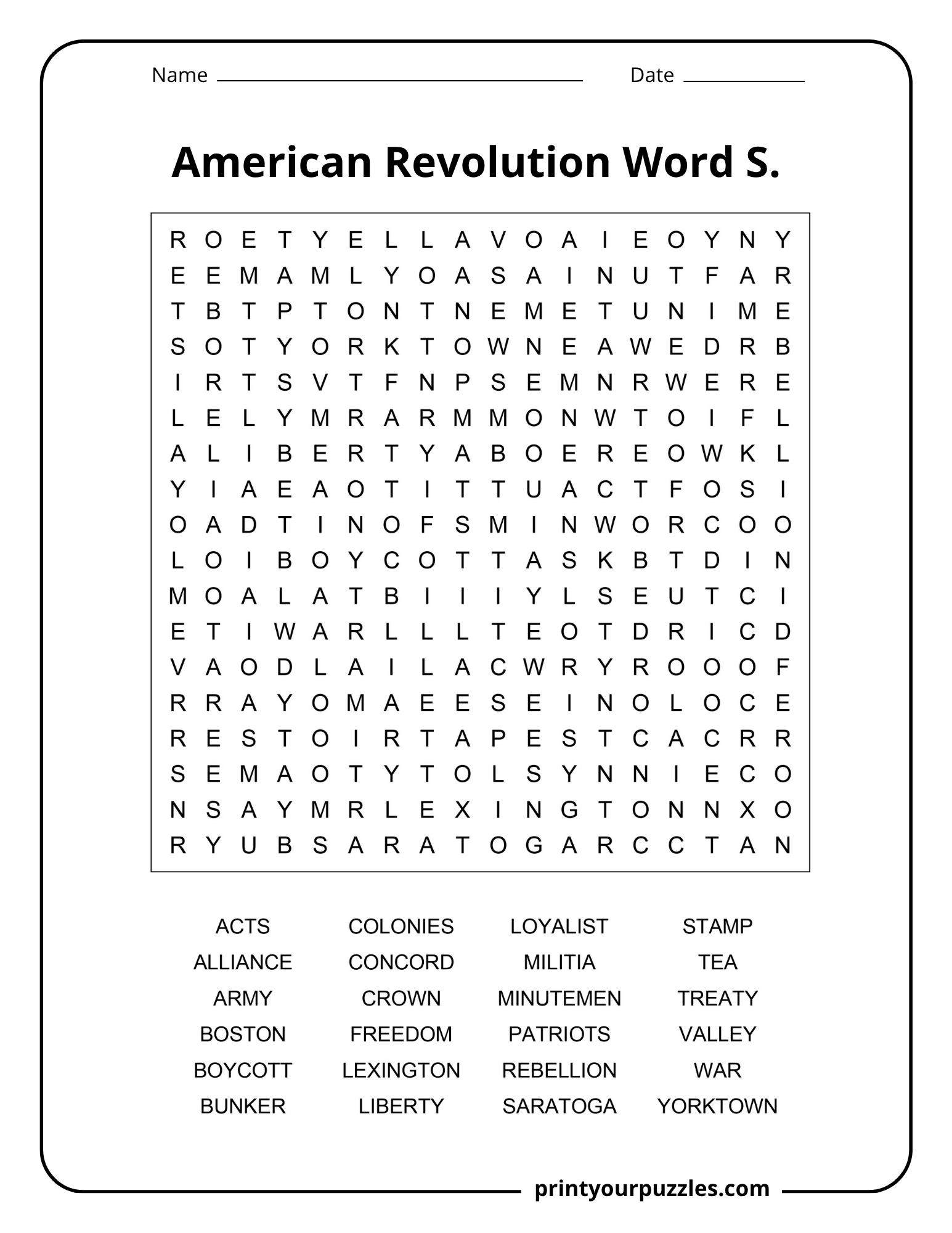
Medium Difficulty Word Search
Words to Find
ACTS. ALLIANCE, ARMY, BOSTON, BOYCOTT, BUNKER, COLONIES, CONCORD, CROWN, FREEDOM, LEXINGTON, LIBERTY, LOYALIST, MILITIA, MINUTEMEN, PATRIOTS, REBELLION, SARATOGA, STAMP, TEA, TREATY, VALLEY, WAR, YORKTOWN
All Words Defined
ACTS – British laws such as the Stamp Act and Tea Act imposed taxes and restrictions on the colonies, increasing anger and encouraging organized resistance against Parliament.
ALLIANCE – The 1778 alliance between France and the United States brought essential military support, weapons, money, soldiers, and naval power that greatly strengthened the American cause.
ARMY – The Continental Army was created by the Second Continental Congress in 1775 and commanded by George Washington throughout the difficult and lengthy fight for American independence.
BOSTON – Massachusetts city where major revolutionary events occurred, including the Boston Massacre, Boston Tea Party, and important protests against British taxation and control over the colonies.
BOYCOTT – Colonists used boycotts to refuse British goods, placing economic pressure on merchants and Parliament while demonstrating united opposition to unpopular taxes and restrictive trade policies.
BUNKER – Bunker Hill was the name associated with a major 1775 battle near Boston, where colonial forces proved they could strongly resist experienced and disciplined British troops.
COLONIES – Thirteen British colonies along North America’s Atlantic coast united against British rule and eventually declared themselves independent states, forming the new United States of America.
CONCORD – Massachusetts town where colonial militia confronted British troops in April 1775, helping begin the Revolutionary War after fighting had first erupted earlier at nearby Lexington.
CROWN – The Crown represented King George III and British royal authority, which many colonists increasingly viewed as oppressive, distant, and unwilling to respect their political rights.
FREEDOM – Freedom was a central revolutionary ideal expressing the colonists’ desire to govern themselves, resist unfair laws, and live without direct control from the British government.
LEXINGTON – Massachusetts town where the first armed clash of the Revolutionary War occurred on April 19, 1775, between colonial militia members and advancing British regular soldiers.
LIBERTY – Liberty described the political and personal rights colonists believed they deserved, including representative government, fair taxation, free expression, and protection from arbitrary and excessive British power.
LOYALIST – A Loyalist was an American colonist who remained faithful to Britain during the Revolution, often opposing independence and supporting the king, government, or British military.
MILITIA – Local groups of civilian soldiers trained to defend their communities, colonial militias fought British troops, guarded supplies, gathered intelligence, and regularly supported the Continental Army.
MINUTEMEN – Minutemen were specially prepared colonial militia members expected to assemble quickly, often within minutes, and respond to emergencies or British military movements in their communities.
PATRIOTS – Patriots were colonists who supported independence from Britain, joined protests, served in military forces, organized resistance, and defended the creation of a new American nation.
REBELLION – Britain viewed the colonial struggle as a rebellion against lawful authority, while many Americans considered it a justified revolution defending natural rights, liberty, and representative self-government.
SARATOGA – The American victory at Saratoga in 1777 became a major turning point because it encouraged France to openly and directly support the United States against Britain.
STAMP – The Stamp Act of 1765 required colonists to pay taxes on printed materials, provoking widespread protests and popularizing demands for representation in decisions about taxation.
TEA – Tea became a symbol of resistance after the Tea Act and Boston Tea Party, when colonists protested British taxation by destroying imported tea in Boston Harbor.
TREATY – The Treaty of Paris, signed in 1783, officially ended the Revolutionary War, recognized American independence, and established national boundaries for the newly formed United States.
VALLEY – Valley Forge was the Continental Army’s winter camp during 1777–1778, where soldiers endured hunger, cold, disease, and shortages while receiving valuable discipline and military training.
WAR – The Revolutionary War lasted from 1775 to 1783, involving battles across the colonies and finally ending with British recognition of an independent United States of America.
YORKTOWN – Virginia site where American and French forces surrounded General Cornwallis in 1781, forcing a major British surrender that effectively ended large-scale fighting in the Revolution.
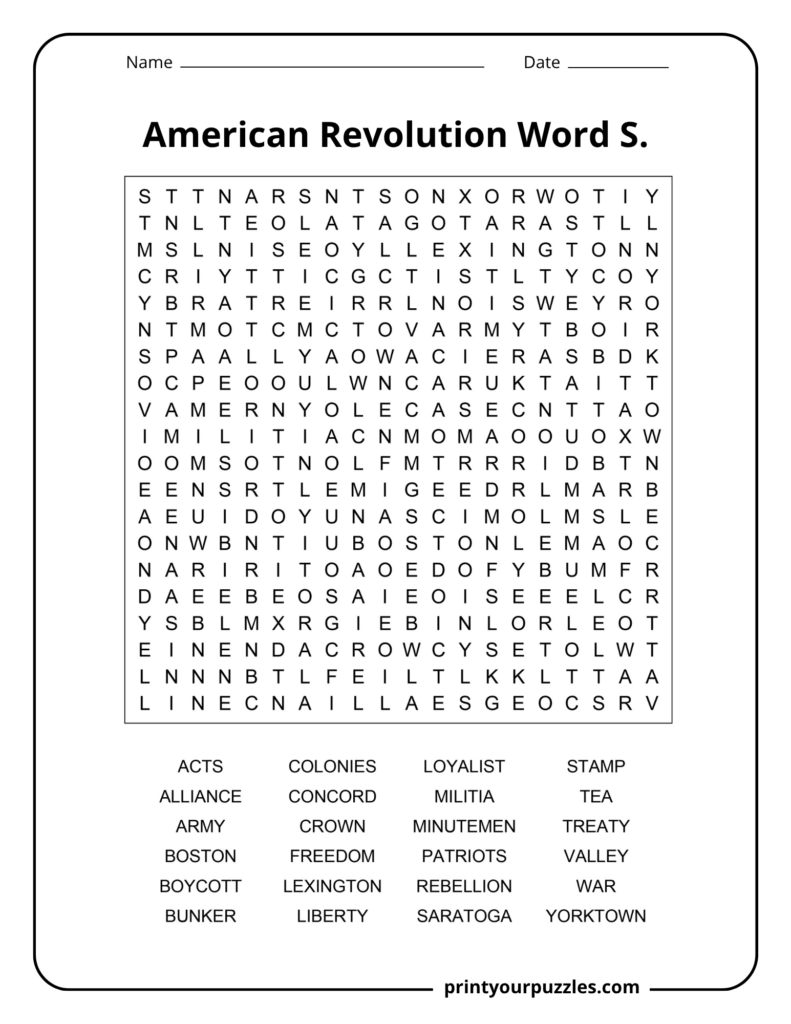
Hard Difficulty Word Search
Words to Find
ACTS. ALLIANCE, ARMY, BOSTON, BOYCOTT, BUNKER, COLONIES, CONCORD, CROWN, FREEDOM, LEXINGTON, LIBERTY, LOYALIST, MILITIA, MINUTEMEN, PATRIOTS, REBELLION, SARATOGA, STAMP, TEA, TREATY, VALLEY, WAR, YORKTOWN
5 Key FAQs About American Revolution
5 Curious "Did You Know?" Facts About American Revolution