Teaching U.S. history means introducing students to an enormous collection of people, places, events, documents, movements, ideas, and unfamiliar vocabulary. From the American Revolution to the Civil Rights Movement, almost every new unit asks students to remember not only what happened, but also who was involved, where events took place, what important terms mean, and how one development connects with another.
That can be a lot to absorb.
Word searches offer a simple and engaging way to introduce and reinforce some of that vocabulary. Used thoughtfully, they can be much more than an activity for filling a few quiet minutes. They can help students become familiar with important terms, activate prior knowledge, review material they have already studied, and make connections across different periods of American history.
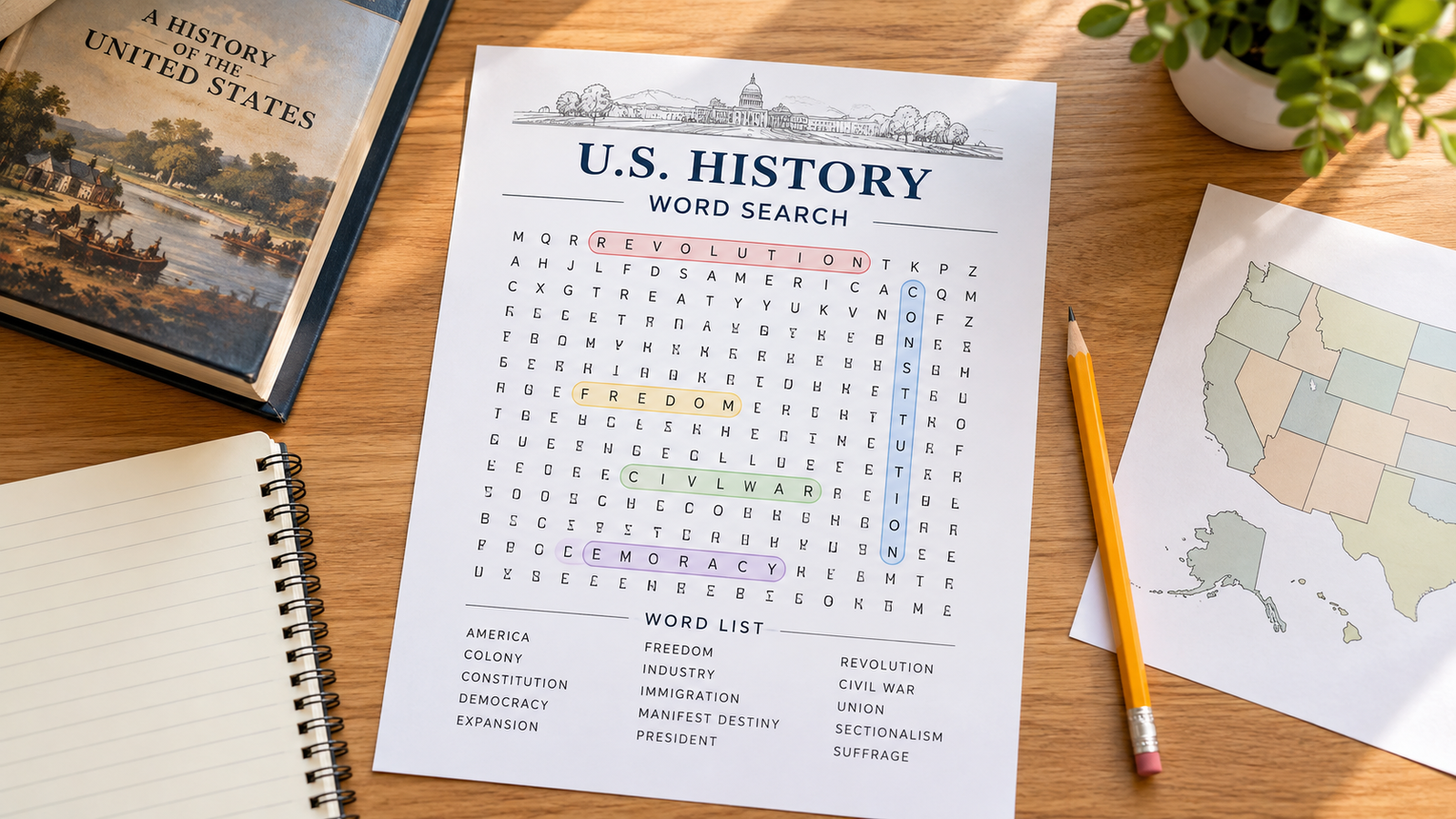
The printable U.S. History Word Searches at Print Your Puzzles are designed to support that kind of learning. Every post begins with an introductory text of approximately 300 words that clearly explains the historical topic before students encounter the puzzle. Each activity then provides 24 carefully selected words to find, together with a definition for every term, Medium and Hard versions of the printable puzzle, FAQs, and additional historical facts. Many U.S. History posts also include a four-question quiz, with answers, based on the information presented on the page.
The puzzle itself may take only part of a lesson. What teachers do with the introductory text, those 24 words, their definitions, and the additional activities afterward can turn it into a much richer history resource.
Here are some practical ways to use word searches in the U.S. history classroom.
1. Introduce a New History Unit Through Vocabulary
A word search can work particularly well at the beginning of a unit, before students have studied the subject in detail.
One useful approach is to begin with the short introductory text accompanying the puzzle. At approximately 300 words, it provides students with enough background to understand the basic subject without requiring them to begin with a long textbook chapter. Teachers can read it together with the class, assign it as independent reading, or ask students to identify two or three facts they consider particularly important.
Imagine beginning a lesson about the American Revolution. After gaining a basic overview of the topic, students encounter 24 related words in the puzzle. Before explaining Lexington, Saratoga, Loyalists, militias, boycotts, or Valley Forge in greater depth, they have already seen some of the vocabulary that will appear throughout the unit.
At this stage, they do not need to understand every term. The objective is familiarity.
After the puzzle, ask students to circle or write down three words they already recognize and three they have never encountered before. That gives the teacher a quick picture of existing knowledge while encouraging students to become curious about unfamiliar vocabulary.
Later, when words such as militia, Saratoga, or Loyalist appear in a textbook, presentation, documentary, or classroom discussion, they are no longer completely new.
The same approach can introduce subjects such as the Bill of Rights, Civil War, Great Depression, or Cold War.
The word search becomes a low-pressure first encounter with the unit rather than a test of knowledge students have not yet acquired.
2. Build Historical Vocabulary Before Reading
History has its own language.
Words such as annexation, reconstruction, industrialization, emancipation, segregation, and containment represent complicated ideas. Students who do not understand those terms can struggle with an entire paragraph even when their general reading ability is strong.
A word search gives teachers an opportunity to identify important vocabulary before asking students to work through a longer reading assignment.
For example, a lesson about the Industrial Revolution might introduce vocabulary associated with factories, machinery, labor, railroads, steel, production, and urban growth.
After finding the words, students could choose five unfamiliar terms and use the definitions provided with the puzzle to explain each one in their own words.
This is one of the advantages of having the definitions directly alongside the activity. Students do not simply find a collection of disconnected words; they have an immediate reference that explains what those terms mean in the context of the topic.
Another option is prediction. Before beginning the lesson, ask students:
Which five words do you think will be most important to understanding this topic?
Return to the question after the lesson. Would they choose the same five?
Now students are not simply recognizing vocabulary. They are thinking about its historical importance.
3. Teach Cause and Effect by Connecting Different Puzzles
One of the biggest challenges in learning history is understanding that events do not happen independently.
A sequence of related word searches can help students see cause, consequence, and historical development.
Consider westward expansion. A teacher could begin with the Louisiana Purchase and Lewis and Clark, then move into territorial growth, migration, and Westward Expansion.
The story can continue through Texas Annexation, the Oregon Trail, the Mexican-American War, the California Gold Rush, and the consequences of expansion for Native Americans.
Students can then use vocabulary from several puzzles to answer larger questions.
What encouraged Americans to move west? How did territorial growth affect relations with Mexico? What happened to Native peoples as settlement expanded? Which political disputes grew as the United States acquired more land?
This approach transforms individual puzzles into pieces of a historical narrative.
4. Create Mini-Units Around Major Periods of U.S. History
Word searches become particularly useful when several related topics are organized into a mini-unit.
For the Civil War era, teachers might begin with the causes of sectional conflict and then use the Civil War, Civil War Causes, Civil War Battles, Civil War Generals, and Civil War Women activities. The Emancipation Proclamation can lead naturally into questions about slavery and freedom, followed by the Reconstruction Era and the enormous challenges that followed the war.
Another sequence could explore the transformation of the United States during the early 20th century:
Progressive Era → Roaring Twenties → 1929 Stock Market Crash → Great Depression → Dust Bowl → New Deal
Students can use the vocabulary from each puzzle to build a classroom timeline. They could place selected words beneath the correct period, identify concepts that continue across several topics, or explain how conditions in one era contributed to developments in the next.
Because every Print Your Puzzles post also contains an introductory explanation of the topic, teachers can use these connected pages as short background readings before moving into more detailed classroom materials.
The activities remain simple, but the thinking becomes increasingly historical.
5. Connect Presidents With the Events of Their Time
Presidents are much easier to remember when students associate them with events rather than learning a list of names and dates in isolation.
Print Your Puzzles has word searches for all U.S. presidents, allowing teachers to combine the U.S. Presidents Word Searches with the history collection.
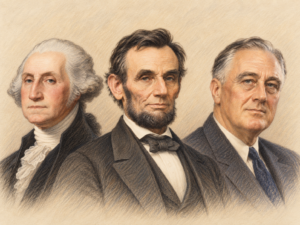
George Washington can accompany the American Revolution and the founding of the new nation. Thomas Jefferson fits naturally with the Louisiana Purchase and Lewis and Clark. James Madison can be connected to the War of 1812.
Later, Abraham Lincoln provides an anchor for the Civil War and Emancipation Proclamation. Franklin D. Roosevelt connects the Great Depression, New Deal, and Pearl Harbor. Harry Truman can be studied alongside the Truman Doctrine and the beginning of the Cold War.
The presidential pages offer another useful classroom feature: every U.S. president post includes a four-question quiz with answers based on the information provided on the page.
That means a teacher could create a simple sequence:
Read → Find → Define → Quiz.
Students first read the approximately 300-word introduction, complete the word search, review the 24 definitions, and finally answer the four questions without returning to the text if the teacher wants a quick recall exercise.
The activity can also be as simple as asking:
Who was president when this happened?
For older students, extend it:
What decisions did that president make? What options were available? What were the consequences?
Presidential puzzles can therefore help students build a chronological framework for the wider history they are studying.
6. Turn the 24-Word List Into a Second Classroom Activity
Finding all the hidden words does not need to end the lesson.
In many cases, the vocabulary list is more useful after the puzzle has been completed.
Teachers can ask students to choose three words and explain how they are connected. They might arrange five events or people in chronological order, divide vocabulary into categories, or write one sentence explaining the historical importance of each selected term.
Another activity is “Choose the Five.”
Imagine that the puzzle could contain only five of its original 24 words. Which five are essential for understanding the subject?
A student working on the Great Depression, for example, must decide which terms best represent the causes, experiences, people, and responses connected with the period.
There is rarely one perfect answer. That is precisely what makes the exercise useful. Students have to make a choice and defend it with historical reasoning.
You can also turn the activity around: give students five terms from the puzzle and ask them to write a short paragraph connecting all five correctly.
7. Use the Built-In Quiz as a Quick Knowledge Check
Many of the U.S. History posts, as well as every U.S. president post, include a four-question quiz with answers based directly on the information students have just read.
This creates an easy opportunity for retrieval practice.
The quiz could be completed immediately after reading the introduction, after finishing the word search, or at the end of the lesson. Teachers could also save it until the following day to see how much information students remember without rereading the page first.
Because there are only four questions, the quiz does not need to feel like a formal assessment. It can function as a quick classroom check: Did students understand the basic topic? Which facts were remembered? Which ideas need another explanation?
Teachers can also ask students to create a fifth question of their own.
That small addition changes the student from someone answering questions into someone deciding what information is important enough to test.
8. Reinforce Civil Rights History Through Connected Topics
The Civil Rights Movement is particularly well suited to connected activities because individual people, protests, court decisions, organizations, and laws form part of a much larger story.
A teacher could begin with Rosa Parks and continue with the Montgomery Bus Boycott. From there, students might study Martin Luther King Jr., the broader Civil Rights Movement, and the Civil Rights Act.
Instead of simply completing each puzzle separately, students could collect important vocabulary as the unit progresses.
At the end, ask them to classify the words into categories such as people, organizations, protests, places, laws, ideas, and methods of activism.
Another possibility is to build a timeline using selected vocabulary from several puzzles and then ask students to explain why putting events in chronological order matters.
This helps demonstrate an essential lesson of history: major social change usually develops through many people and actions over time, rather than through one isolated event.
9. Pair Word Searches With Timelines, Maps, and Primary Sources
A word search works best as one part of a larger history lesson.
After students complete a puzzle, the vocabulary can easily be transferred to another type of activity.
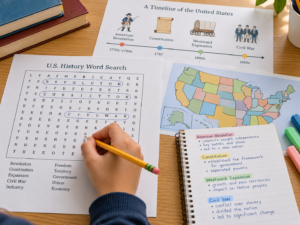
For westward expansion, place locations from the word list on a map. For the Civil War, locate major battles. For the Great Depression, create a timeline showing the stock market crash, Dust Bowl years, elections, and New Deal programs.
Primary sources can make the connection even stronger.
After a Bill of Rights puzzle, students might examine selected amendments. After the American Revolution, they can read a short passage from the Declaration of Independence. A Civil Rights lesson might combine puzzle vocabulary with speeches, photographs, newspaper reports, or legislation from the period.
Students can then highlight puzzle terms when they encounter them in the original source.
This creates an important bridge between recognizing a historical word and understanding how that word functions in real historical evidence.
The introductory text provides the overview. The 24 terms and definitions establish the vocabulary. The puzzle reinforces recognition. Maps, timelines, documents, photographs, discussion, and quizzes then provide additional ways to work with that information.
10. Differentiate Activities for Different Learners
Not every student needs exactly the same level of challenge.
Each U.S. History topic at Print Your Puzzles includes a Medium 18×18 puzzle and a more challenging Hard 20×20 version using the same 24 vocabulary terms.
That makes basic differentiation straightforward without requiring teachers to introduce a different set of content.
The Medium version can be useful when vocabulary practice is the main goal, while the Hard puzzle offers additional challenge for students who enjoy more difficult searches.
Teachers can also differentiate what happens after the puzzle.
Some students might match five terms to definitions. Others could write sentences, explain cause-and-effect relationships, or use several terms in a short historical paragraph.
For English-language learners or students who need additional vocabulary support, the combination of a short introductory text, repeated vocabulary, definitions, and the visual task of locating the words can provide several encounters with the same historical terminology before longer reading begins.
Word searches can also work well for paired activities, independent practice, homeschool lessons, learning stations, homework, substitute-teacher plans, or early finishers.
The difficulty of the historical thinking can change even when everyone begins with the same 24 words.
11. Use the Same Puzzle Before and After a Unit
One particularly useful method is to use a word search twice.
At the beginning of a unit, the words may be mostly unfamiliar. Students are simply discovering the vocabulary.
After several lessons, use the same word list again—but change the task.
Now ask students to select ten terms and explain them without looking at their notes. Ask them to connect one person with one event, identify a cause and a consequence, or explain which three words they consider most significant.
A World War II lesson might revisit vocabulary from Pearl Harbor and D-Day. A Cold War unit could return to words associated with containment, the Truman Doctrine, the Cuban Missile Crisis, or the Space Race.
Later periods can use the same technique with the Vietnam War or Watergate Scandal.
If the post includes a four-question quiz, teachers also have another option: students can answer it before the unit and repeat the questions afterward. The comparison gives a quick indication of how their understanding has changed.
The puzzle has not changed, but the student’s relationship with the vocabulary has.
12. Build a U.S. History Puzzle Library Across the School Year
Instead of using word searches only occasionally, teachers can build them into the rhythm of a U.S. history course.
The school year might begin with Native Americans, colonial America, the Revolution, and the founding period. It can then move through territorial expansion, the Civil War and Reconstruction, industrialization, the Progressive Era, and events such as the Spanish-American War.
The 20th century opens another long sequence: the Roaring Twenties, Great Depression, New Deal, World War II, Cold War, Civil Rights Movement, Vietnam, and Watergate.
This approach has an additional advantage: students encounter a familiar resource structure repeatedly while the historical content changes.
They know that each new topic will provide a concise introduction, 24 key terms with definitions, and two levels of word search. On many history topics, they will also find a four-question quiz. That consistency means less classroom time explaining how the resource works and more time concentrating on the history itself.
Over the course of the year, students gradually build their own mental library of names, events, places, concepts, and connections.
From Finding Words to Understanding History
A word search cannot replace historical reading, primary sources, maps, timelines, discussion, writing, or thoughtful teaching—and it is not supposed to.
Its strength lies somewhere else.
A well-designed history activity can provide several layers of learning within a single topic. Students can begin with a concise introduction, encounter 24 important terms, learn what those words mean, reinforce them through the puzzle, explore related facts and questions, and—in many posts—finish with a short quiz to check their understanding.
The most important part of the activity may actually begin after the final hidden word has been found.
What do these words mean? Which belong together? What happened first? What caused the next event? Who was affected? Which terms represent change, conflict, or continuity? Which five words best explain the entire topic?
Those questions move students beyond recognition and toward historical understanding.
And that is where a simple word search becomes something more useful: not the whole history lesson, but an engaging doorway into the larger story of the United States.